http://www.marketwired.com/press ... YSE-AMD-1852095.htm
話效能提 升唔少
留意 note #1, #2
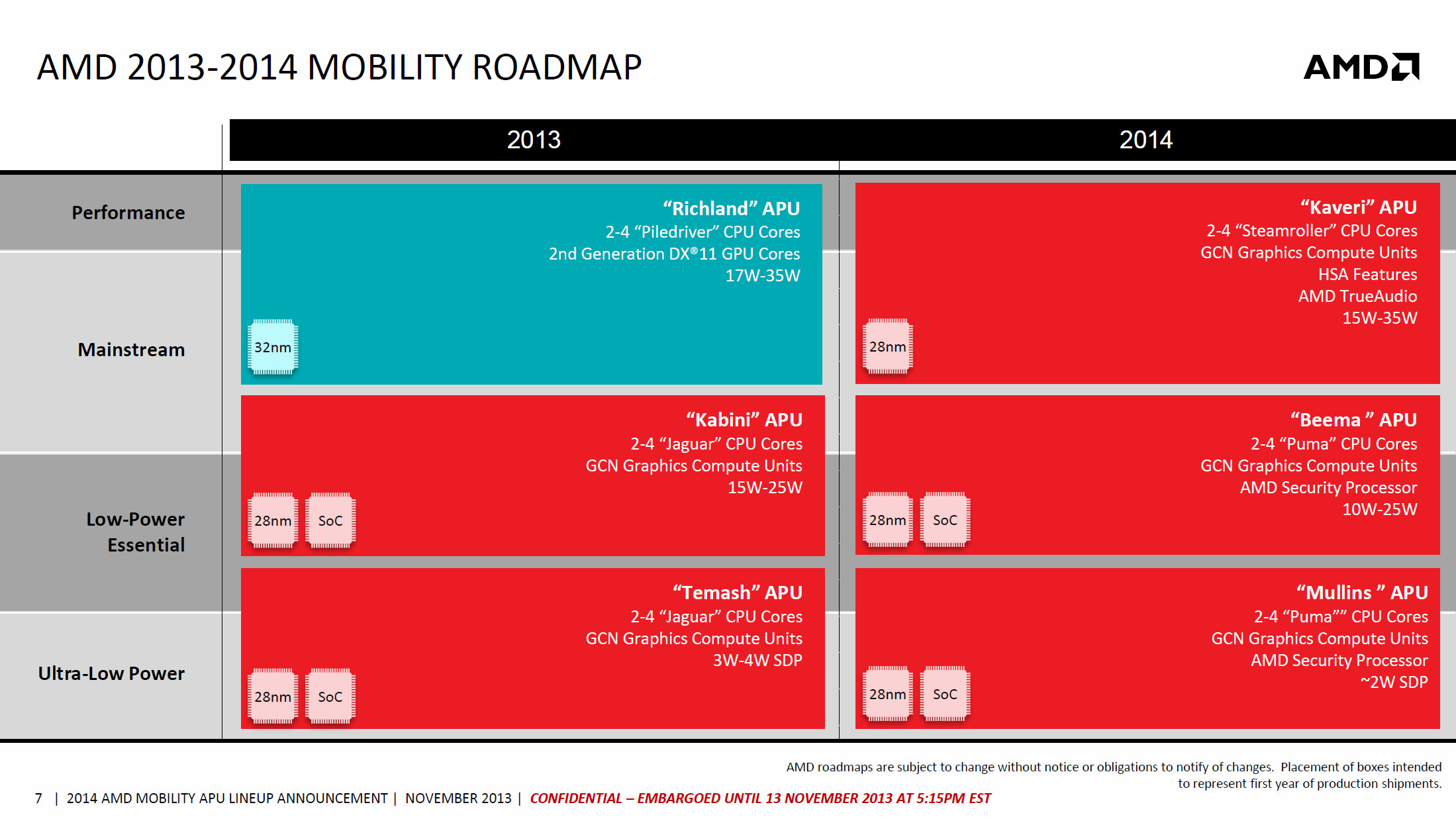
1. The new 2014 AMD A-Series low power APU platform, codenamed "Mullins," is expected to deliver up to 139 percent better productivity performance per watt when compared to the previous generation "Temash" platform. Testing conducted by AMD Performance Labs on optimized AMD reference systems. PC manufacturers may vary configuration yielding different results. PCMark 8 - Home score divided by TDP (W) is used to simulate productivity performance per watt; the Mullins platform (4.5W) scored 1809 while the Temash platform (8W) scored 1343. AMD "Larne" reference platform system used for both APUs. Temash-based AMD A6-1450 quad-core APU with AMD Radeon™ HD 8250 Graphics, 2x2GB of DDR3-1333MHz RAM (running at 1066MHz), Windows 8.1, 13.200.11.0 - 03-Sep-2013 driver. Pre-production engineering sample of "Mullins" quad-core APU with next generation AMD Radeon graphics (model number TBD), 2x2GB DDR3-1333MHz RAM, Windows 8.1, and unreleased reference driver. MUN-3
2. The new 2014 AMD A-Series mainstream APU platform, codenamed "Beema," is expected to deliver up to 104 percent better productivity performance per watt when compared to the previous generation "Kabini" platform. Testing conducted by AMD Performance Labs on optimized AMD reference systems. PC manufacturers may vary configuration yielding different results. PCMark 8 - Home score divided by TDP (W) is used to simulate productivity performance per watt; the Beema platform (15W) scored 2312 while the Kabini platform (25W) scored 1861. AMD "Larne" reference platform system used for both APUs. Kabini-based AMD A6-5200 quad-core APU with AMD Radeon™ HD 8400 Graphics, 2x2GB of DDR3-1600MHz RAM, Windows 8.1, 13.200.11.0 - 03-Sep-2013 driver. Pre-production engineering sample of "Beema" quad-core APU with next generation AMD Radeon graphics (model number TBD), 2x2GB DDR3-1600MHz RAM, Windows 8.1, and unreleased reference driver. BMN-3 |
 簡體版
簡體版 訂閱頻道
訂閱頻道 訂閱電子報
訂閱電子報




 發表於 2013-11-14 11:33
|
發表於 2013-11-14 11:33
|